
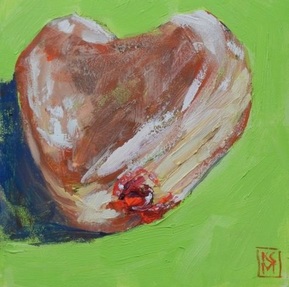
Donut War Jelly Heart, Acrylic Painting of Dunkin Donuts Jelly by Kelley MacDonald
berliners
No essay concerning any German donut is complete without a mention of John F. Kennedy.
A few decades ago while touring Germany I noticed that the bakeries did not sell jelly donuts. They sold berliners. I remember asking a sales clerk why the jelly donuts were called "Berliners." I was given a look of condescension, most likely because I could only speak English, and was told "because they are berliners." Fighting back visions of Sweeney Todd, I was seriously afraid to try one, not knowing what it may contain. The only other time I had heard the term "Berliner" was while watching a 1963 (yes, I am that old) television broadcast of John F. Kennedy in Berlin. I heard him tell the world "Ich bin ein Berliner." It was a moving post WWII speech inferring that we, all, are Berliners; from Berlin; we are one world.
Could mass jelly donut consumption be a Germanic celebration of unity?
Thinking this was an odd name for a pastry, I asked a few of my more linguistically and gastronomically knowledgeable co-workers the same question: "Why are the jelly donuts called "Berliners?" I received virtually the same answer from my co-workers, “it's because they are called berliners." I think it was a cellist who said, "That's right. JFK unwittingly told the world he was a donut."
Spurred by curiosity, I have read various articles debating JFK's "Berliner" statement. Was it an awkward, near international incident-inciting faux pas? Or was the statement technically correct in German grammar? Most arguments seemed to vindicate JFK's usage of the term.
The great JFK debate does not, however, address why jelly donuts are referred to as berliners.
In 2010 Gil Marks wrote in his "Encyclopedia of Jewish Food" that:
"Since at least the early 1800s, Germans had called jelly doughnuts simply Berliners. According to a German anecdote, in 1756 a patriotic baker from Berlin was turned down as unfit for Prussian military service, but allowed to remain as a field baker for the regiment. Because armies in the field had no access to ovens, he began frying doughnuts over an open fire, which the soldiers began calling after the baker’s home, Berliners."
Read more at:
http://leitesculinaria.com/60405/writings-histotry-of-sufganiyah.html
Armed with this second-hand information, I concluded that in 1878 Thomas Albert Hersey Junior (1864-1956) could very well have referred to his grandmother's pastries as berliners.
A few decades ago while touring Germany I noticed that the bakeries did not sell jelly donuts. They sold berliners. I remember asking a sales clerk why the jelly donuts were called "Berliners." I was given a look of condescension, most likely because I could only speak English, and was told "because they are berliners." Fighting back visions of Sweeney Todd, I was seriously afraid to try one, not knowing what it may contain. The only other time I had heard the term "Berliner" was while watching a 1963 (yes, I am that old) television broadcast of John F. Kennedy in Berlin. I heard him tell the world "Ich bin ein Berliner." It was a moving post WWII speech inferring that we, all, are Berliners; from Berlin; we are one world.
Could mass jelly donut consumption be a Germanic celebration of unity?
Thinking this was an odd name for a pastry, I asked a few of my more linguistically and gastronomically knowledgeable co-workers the same question: "Why are the jelly donuts called "Berliners?" I received virtually the same answer from my co-workers, “it's because they are called berliners." I think it was a cellist who said, "That's right. JFK unwittingly told the world he was a donut."
Spurred by curiosity, I have read various articles debating JFK's "Berliner" statement. Was it an awkward, near international incident-inciting faux pas? Or was the statement technically correct in German grammar? Most arguments seemed to vindicate JFK's usage of the term.
The great JFK debate does not, however, address why jelly donuts are referred to as berliners.
In 2010 Gil Marks wrote in his "Encyclopedia of Jewish Food" that:
"Since at least the early 1800s, Germans had called jelly doughnuts simply Berliners. According to a German anecdote, in 1756 a patriotic baker from Berlin was turned down as unfit for Prussian military service, but allowed to remain as a field baker for the regiment. Because armies in the field had no access to ovens, he began frying doughnuts over an open fire, which the soldiers began calling after the baker’s home, Berliners."
Read more at:
http://leitesculinaria.com/60405/writings-histotry-of-sufganiyah.html
Armed with this second-hand information, I concluded that in 1878 Thomas Albert Hersey Junior (1864-1956) could very well have referred to his grandmother's pastries as berliners.
Fleischmann's Yeast
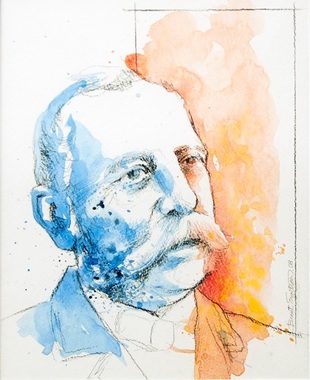
Charles Louis Fleischmann (1835 – 1897) Baking Hall of Fame from the American Society of Baking
by Brent Engstrom 2008
You may have been surprised to read that Thomas Albert Junior would have known about or made use of Fleischmann's Yeast in 1878. Undoubtedly an exciting revolution for a young baker like Thomas, It was as early as 1868 when Charles Fleischmann began to market compressed yeast. According to one of his granddaughters, Thomas Albert Junior, a baker all of his life, was one of the first chefs hired by the Hotel Del Coronado in San Diego in the late 1880's. He first appears as a "baker" in the 1881 Census of Canada at the age of only sixteen. After a brief try at farming in Fullerton, Thomas Junior and his wife Susan Jane Langford VanSkike Hersey (1861–1942) managed a boarding house in the 1920's on Central Ave in La Habra. I presume that he did much, if not all, of the cooking.
Note: Many thanks to Margaret Hall for her assistance with my pig-din attempts at the German language; she offered, however, no insight into the donut debate.
For further reading:
The history of the Jelly Donut
Doughnut vs. donut
Berliner (doughnut)
JFK: "I Am a Jelly Donut" ("Ich Bin ein Berliner")
From the Urban Legends Mailbag
The Real Meaning of Ich Bin ein Berliner From The Atlantic
Note: Many thanks to Margaret Hall for her assistance with my pig-din attempts at the German language; she offered, however, no insight into the donut debate.
For further reading:
The history of the Jelly Donut
Doughnut vs. donut
Berliner (doughnut)
JFK: "I Am a Jelly Donut" ("Ich Bin ein Berliner")
From the Urban Legends Mailbag
The Real Meaning of Ich Bin ein Berliner From The Atlantic
 RSS Feed